Pain & Patience
Pain is a language beyond words. It is something that calls for attention, not avoidance. Pain is a complex web of bones aching, muscles screaming, nerves firing, chemicals flooding, emotions erupting, thoughts pulsating—all often entangled, and in a way, holding you hostage until you listen. But listening is not enough, because pain is proof that we are alive—yet it makes us wish we weren’t. It makes us resilient, but doesn’t ask for permission, pain demands to be felt—whether it is a broken toe or a broken promise, therefore pain is the most honest thing you will ever experience. The real question isn’t just what pain is, but what it is trying to tell you, and whether or not you are ready to listen.
I have been fascinated with pain my whole life. It’s one of those things that are so elusive and yet so present in our lives. We have memories attached to pain in ways we can’t fully explain but we can definitely feel it strongly. Most often, pain is not something we choose, it just happens to us, and yet, sometimes we can choose a path that will hold the risk of pain and we still choose it! No matter how we see it, pain will be an integral part of our lives.
One of the main things that happened in my life that defined me early on was that I had an underbite that developed in my teenage years. This was a pain I didn’t choose but thankfully I could choose to deal with it by going through extensive jaw surgery when I was 20 years old with a lengthy preparation for about 5 years with braces that had to be tightened once every month, and the following years after the surgery I dealt with numb nerves and readjustment for my new jaw and my new face. This feeling of pain became so common for me that going to the dentist felt nice! I know, that’s kinda weird. And the pain of this was far beyond the physical experience of it, as I was bullied in my teens for the way I looked, and so I had a deep internal pain around it and it was something that made me very insecure, shy, and secluded and this pain affected my adulthood to the point where confidence wasn’t really something I found until in my mid-thirties.
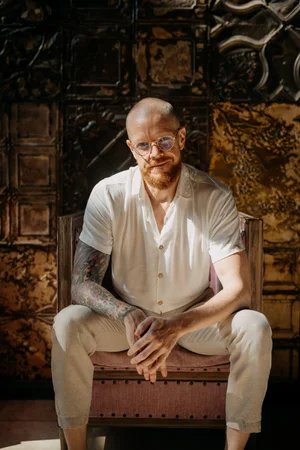
A deliberately chosen pain that I’ve dealt with is of course tattoos. Now why would I choose to go through this kind of pain? Well, this is art to me, a few hours of pain for a lifetime of art on my body. It can be a very ritualistic experience too, I’ve gone to some deep states of my mind and body during the process. It becomes a constant reminder where each time I look at it I feel proud of myself for going through a brief period of physical pain. And to expose yourself to pain doesn’t necessarily mean that you’ll get used to it until it isn’t pain anymore, but you’ll get familiar with the pain, as if you befriend it, and that makes a huge difference.
When it comes to pain and the shared experience of it, whether it is physical, mental and emotional experiences, I think to some extent, we can all relate to one another on this. Be it relational, similar injuries, growing up in similar cultures, family issues—we all have them, right?
And this is what made me very passionate about working with people who live with chronic pain or is dealing with acute pain to help them feel and move better. This also became something I didn’t expect, but the way that we can process pain through a movement or yoga class might actually be very very healing, helpful and give us clarity. The shared experience of a class that is inclusive enough for everyone to feel into their own body as much as they can, a moment for yourself where you are encouraged to slow down and go within not looking for answers, but for more interesting questions, an invitation to realize that no matter what you have experienced in your life, you are not broken, and that there is nothing to be fixed, it’s just a life yearning to be lived fully.
Why did I choose this topic about pain, patience, and self-awareness?
Because pain is such a complex topic I really wanted to understand it and the more people I met in my work, certain types of pain seemed to be reoccurring and it became easier to approach, and as I often meet people who wants to get rid of pain, I often have to remind them that pain can be very persistent and that it will most likely take a long time to fully take care of it, but the patience will pay off with time so that we can move and feel with more self-awareness and this in turn will grant us more confidence and freedom, not just physically, but mentally and emotionally as well. And outside of my work, the interactions I share with friends and strangers seem to have a theme when it comes to pain as well, it can be loneliness, grief, unrequited love, feeling left out, or not being able to feel our emotions, a sense of numbness and hopelessness at the ongoing state of the world. And in the midst of all of this, to hold onto a sense of curiosity for change. That we have to accept that pain is part of life, but it doesn’t have to dictate us so much, and that change is a healthy and natural part of our life, whether we change—or rather become ourselves more and more—or that our environment changes and the more we resist that, it probably won’t work in our favor.
What is pain? (Scientific vs poetic)
Scientific Version: Pain is your nervous system's alarm program. When tissues are damaged or threatened, specialized sensors called nociceptors fire electrical signals through your nerves to your spinal cord and brain. Your brain then processes this information across multiple regions—identifying where the pain is coming from, how intense it feels, and attaching an emotional weight to it. This process triggers automatic responses like pulling your hand away from heat—or protecting an injured area such as moving an aching knee less—or not putting weight on our painful wrists. Pain can be acute (short-term, tied to clear injury) or chronic (lasting months or years, sometimes persisting even after healing). In chronic cases, the nervous system can become oversensitive, continuing to send pain signals even without active tissue damage. Understanding this mechanism helps explain why pain doesn't always match visible injury and why treatments often target the nervous system itself, not just the site of damage.
Poetic Version: Pain is the body's ancient language, speaking in a dialect older than words. It arrives uninvited—a sharp guest at the door of awareness, demanding attention with the urgency of a breaking storm. Sometimes it whispers, a dull ache that lingers like an old memory refusing to fade; sometimes it screams, like white-hot lightning that fractures time itself. It is both messenger and prisoner, carrying warnings from the edges of our flesh to the quiet center where we live. Pain reminds us we are mortal, that we are bound to this fragile vessel of bone and blood. Yet in its presence, there is also a strange intimacy—the way suffering can strip away pretense, leaving only the raw truth of being alive. It is the shadow that proves the light exists, the silence between notes that gives music its shape.
Pain has always been a creative topic for the human experience, and we find it in literature, art, music, film, poetry, and dance throughout time. It is something we can relate to deeply, even though we do not know the person who wrote, said, or performed it, but somehow we feel like it’s speaking to us on an intimate level, because pain is a shared experience, it transcends the individual and touches us beautifully to remind us of our precious life.
QUOTES ON PAIN
Virginia Woolf
"I am a woman and I have a heart which is often bruised and broken by the world's indifferent cruelty."
Toni Morrison
"If you surrender to the pain, it will not defeat you; it will teach you how to rise."
Pain in art can be a profound experience, it can inspire us to pursue dreams, to find courage, to seek for closure, and so many other things. And that for some people this pain was so unbearable that they felt compelled to make art out of it. I think we can all name a song, a film, a book, or maybe even some art work, that had such a profound effect on us that it feels like it was made for us, right? It speaks to us on so many levels, and to think about it, a person felt or thought of something so intensely that they had to make something out of it, and then here you are, completely unrelated to this person, it might even have been years ago where this was created, and yet somehow it plucked on your heart strings and made you feel something so inexplicably profound. How fascinating is that? How deeply connected we all are to one another where it even transcends time.
Pain is on a spectrum
When we look at pain in rudimentary ways, we might distinguish between an emotional pain, a mental pain, and a physical pain—but this is looking at it from an isolated point of view, and to look at it from a more integral and interrelated spectrum, we begin to see and feel the threads that weave these aspects of pain together. A physical pain will have an emotional and mental attachment, a mental pain might have a physical expression tied to an emotional connection, and so on.
Pain is delicately woven into the ecosystem of our full human experience, where no internal system works alone, and isn’t treated or changed alone either. A short term pain expression might cause a mental attachment that stays for very long.
I remember a client of mine—one who had an accident maybe 15 years ago, she broke her shoulder and with time it healed mechanically, but the neuromuscular connection held onto it like a bad memory so she hadn’t been able to lift her arm over her head for all those years because she feared it was going to get worse if she did. We did some movement patterns, tried some mobility and strengthening exercises and within minutes she lifted her arm over her head. Nothing magical, just simple mind-body connection. Tears welled up in her eyes and she felt so grateful and confident all of a sudden because she felt held back for so many years. I have countless client stories that are the same.
Therefore chronic pain can become so integrated into our daily life that we don’t remember what it was like without it! Association will put its sharp talons in our psyche and we begin to equate pain to certain memories.
I for one, got a massage maybe 8 years ago and the masseuse moved with pressure along the back of my knee joint and it nearly dislocated, and since then I tense up every time they move there, because of that one brief second of discomfort, a memory was latched on and keeps reminding me of that pain. I think we all have a similar story somehow of a short term pain experience that has stayed with us.
And pain can become so strong that we build up fear around it, be it a certain movement, a bad breakup, grieving someone who suddenly passed away, so that we mostly avoid similar situations, at least the ones we can control to a certain extent. And yet, pain is part of life, no matter how we deal with it—is that not the beauty and trepidation of pain—that we never truly get used to it, we just have to learn to dance with it.
What about pain and patience?
I remember a few years ago, when I went for a two month teaching tour in Europe, I went to a new city and a new country almost every weekend, I was looking forward to new food, seeing the countryside and walking on cobblestone streets and in parks and teaching people about movement and how to take care of aches and pain! This was the first time I left Bali in about seven years, so as you might know, this is not necessarily a walking-friendly place, so I was very excited to be walking a lot. Embarrassingly enough, I overdid it in the first week and got severe muscle soreness in my feet and ankles—just from walking! I got bad inflammation and was in constant pain, and I had to keep on moving because of the tour. Each day grew worse and worse and I could barely move, and ironically I taught a workshop called Movement is Medicine, so I had to laugh it off while moving around in throbbing pain—long story short, it took almost a full year for the pain to subside, I taught my classes on crutches, I rested, I went to the hospital and got it checked, I trained in the ways I teach others how to deal with pain, and I got frustrated, anxious, felt extremely limited, hell, even walking down stairs was kinda scary!
It took about a year for this inflammation to settle, and when it was gone I decided not only to get back to where I was before this happened but to move and train my body to not let it happen again. I took up running—that’s still a work in progress—I increased and improved my strength training, and what remained was a humble reminder of how small things can cause great restrictions and it really helped me to relate better to people that I work with.
With this understanding, the way we carry ourselves with pain and move through—let’s say a yoga class—we adapt and adjust to our needs, and that might mean avoiding certain poses and movements, which takes away from the full experience, but it also keeps us safe and present. And maybe it also means that this kind of pain dictates our experience more than it should? Therefore approaching pain instead of avoiding it is not only encouraged, it’s necessary. Also, within the complexity of pain, and this is something I experience a lot with my clients, is that we find some new movement patterns that feel good initially. Maybe we do a rotational pattern for the hips and all of a sudden that ache or pinch is felt a little bit less or maybe the pain is gone for a while.
And sometimes I would hear from them the next day saying that they feel MORE pain now, that it’s inflamed or stiffer than before. And oftentimes this isn’t a bad sign, but we interpret that if something doesn’t feel good, we shouldn’t do it again—rather than thinking “the movement felt really good, and now my body is reacting to this new movement, that makes sense,” because the more we do that movement that felt good, the body adapts and learns how to maintain it better, and that ache, pain, or inflammation won’t be as big the next time. The body adapts when we give it new information. But this still requires a lot of patience. It won’t happen overnight.
The same goes for pain that is mental and emotional, and how it might linger in a different way and requires a different approach, but the key thing here is acknowledging that it’s there and that it needs attention. How it then plays out can and will be very individual. A painful breakup might need time and patience to grieve a part of yourself that isn’t there anymore, and yet we might hold onto that part in hopes that something might change and we get to go back, until we loosen the grip of this hope and we find something far more valuable within ourselves. The loss of a loved one might take us so deep into a process that we don’t see a way past it, yet one day the fog clears and we don’t know how it happened, and that is highly individual on how long it takes to process.
Maya Angelou:
"Patience is not passive; on the contrary, it is active; it is concentrated strength."
Ralph Waldo Emerson:
"Patience is not simply the ability to wait—it's how we behave while we're waiting."
Pain Tolerance
How much can a person take when it comes to pain? If you’ve been to my myofascial release classes where we move around on tennis balls, you might have felt certain areas on your body being more sensitive than others, and for the person next to you the same spot might feel like nothing. And so our body responds and reacts differently in terms of pressure and tolerance. We react differently as well, shortness of breath, thoughts racing, our faces grimacing, sweating, and so on. And interestingly enough, this practice is all about patience and adaptation, where we begin to notice the entire experience, how to move slowly, how to make subtle adaptations, how to notice our breath slowing down, our thoughts soften, and our faces relax as we lean onto the tennis ball. Just to bring us into a moment of presence. This is no different from any other approach to pain—beyond the physical. It requires presence, slow and subtle adjustments, witnessing our thoughts, and observing our breath. From this place, we can begin to make the changes happen. Therefore pain tolerance is a skill that can be learned actively—OR it is unfortunately something we are forced to experience on a regular basis that we get so familiar with it.
Just imagine for a second on the global lottery of geographical luck, that on one side of the world, a person who was born and grew up in a part of the world of safety and stability, access to nature, to food, to shelter, to opportunities without much risk—compared to a person who was born and grew up in a part of the world that had none of that, instead constant war, famine, no shelter, no safety or stability, and potentially no rights, what kind of pain each of these people are experiencing and how they are ordained to adapt and tolerate it.
We never know what kind of pain a person is carrying, just by looking at them. We might not know how every step is like walking on broken glass, or how heavy a heart might feel, or see the density of thoughts, because behind those smiles we procure, and those words we utter “I’m good” can be a deeper story left untold. And unless we ask, we will never find out, and unless we dare to share, we won’t understand.
So, we know now that pain is complex, and it takes time to heal, no matter the quality of it, physical, mental, emotional, spiritual—and most likely they are more interwoven than we first assume, therefore we are not just treating a sore muscle or a broken heart, but so much more that we don’t know about.
And so when we approach pain with patience, it’s an acknowledgment of how some days will feel better, other days won’t, because healing and growth is never linear, but more cyclical and dynamic. It requires courage, a sense of walking into the unknown, because remaining in the known—be it physical pain, a mental rut we can’t get out of, or an emotional state that is negatively affecting many parts of our life—will not be sustainable in the long run.
Therefore we are not being passive about it, it is deliberately active, and in the same way, it is not us waiting for it to magically go away—it is us making changes, no matter how big or small, each day. Because change isn’t going to happen in an instant, it happens through consistent effort and attention, making the intention more and more apparent. Pain is a tone slightly out of tune, and patience is your ability to find the right sound again. It requires active listening. It requires fine-tuning.
Pain can be small as a paper cut, or it can be the biggest rift in your heart. And yet the paper cut can be a massive nuisance in your daily life and the rift in your heart might just become something familiar. Therefore pain is also very individual and the experience of it feels uniquely different to each and every one.
It will inform and affect us in so many different ways and our tolerance for it will be unique. Pain and pleasure, shall we even go there? It can be such a deeply psychological experience that we get addicted to pain or love being on the edge of control, and that it becomes a specific way to feel something profound—and that might become our only sense of pleasure.
We might be so used to pain and live a very active and healthy life with it, but when it comes to patience, we barely have any room for it. Or we might be utterly terrified of pain that we live a protected life that doesn’t allow much exploration, physically, mentally, or emotionally. And perhaps the fear of pain is another form of pain itself, what do you think?
Trauma is of course a huge part of this. An experience we had, chosen or not, might have impacted us so deeply that we avoid any resembling action or situation like that again. Is all trauma something we can work on and remove, or is this an imprint or a scar that we have to live with and make the most of it? I think it’s a bit of both, some things can be changed and nearly forgotten, others we manage to maintain in a healthy way. Because pain is so complex, it has no clear way of taking care of, but neglecting it will at the least keep it around and at most we can rise above it.
Acute Trauma - Single incident (car accident, assault)
Chronic Trauma - Repeated exposure (domestic violence, ongoing abuse)
Complex Trauma - Multiple traumatic events, often interpersonal and early in life
Developmental Trauma - Trauma occurring during critical developmental periods
Maya Angelou
"You may not control all the events that happen to you, but you can decide not to be reduced by them."
So a great personal exercise for you is to write down any situation of pain that you’ve experienced or is experiencing right now perhaps. Is it mental, emotional, physical at its main expression? And how does it affect other parts of your life? What would be some specific ways to approach this and how can you gradually—patiently, change it?
Emotional vulnerability
There is a specific kind of pain that is really difficult to notice, it is barely seen at all. It hides—not just for others, but even to ourselves. There is a kind of pain within when it comes to allowing ourselves to feel. I’m talking about emotional vulnerability, to go within our own experience, the ability to recognize and feel our emotional landscape. Some of us have been taught—and to some regard a lot of men—that feeling is bad, that we shouldn’t be emotional, that we don’t cry, that we have to be strong, and we’ve created this strange narrative of how a man is supposed to be and how a woman is supposed to be, obviously depending on where we grew up and the culture that shapes us plays a big role, and yet, are we not a product of our environment so to speak and that in many ways we are conditioned to be something where we might feel like we don’t fit in or belong?
Maya Angelou:
"There is no greater agony than bearing an untold story inside you."
The pain of the unspoken, not allowing ourselves to fully explore our inner world, not allowing ourselves to express how we feel, not allowing ourselves to be vulnerable, messy, confused, this kind of holding ourselves back carries a pain that is simply asking us to be ourselves, yet we are mentally and emotionally severing parts of who we are because we’ve been told to be a certain way. It’s like a voice that can’t speak clearly, it’s a smile that doesn’t erupt fully, it’s a thought that isn’t fully formed. A pain latched onto fear attached to this smaller version of yourself, when you know that you are so much more.
Have you ever been in a situation or time in your life where you didn’t feel like you belonged? Like there was this yearning to be more of yourself than you could be at that moment in life? Perhaps that’s how you feel right now, being here, that you feel more like yourself than at home, anyone that relates to this?
And remember how you felt when you finally spoke up, or materialized that thought, or when your face softened with confidence and ease after years of holding back! What a relief, right? All of a sudden freedom, possibilities and confidence blossomed like never before. What a gift it is to feel, to experience our inner world, to witness our doubts, our insecurities, our fears, and instead of running away, we remain, we stand strong, we face these parts of ourselves directly, and all of a sudden they change, they soften, they show the hidden parts and then it isn’t so scary, it was some kind of pain craving attention, and you gave yourself patience to sit with it, meet it, listen to it, and let it transform you.
Emotional vulnerability is the act of witnessing ourselves fully, and that will be painful sometimes, because we won’t always feel great, and at the same time we won’t always feel bad either. But it is the mere recognition of this ability to feel that has immense value and potency. To suppress emotions, to hold back when we should speak up, to be hesitant when we can be courageous, this will most likely pile up as regrets and ‘what-ifs’ and this weight isn’t something we should carry so often. The burden of feeling is far lighter than the burden of denying those feelings. This pain goes deep and it will express itself through many ways, once again, we are coming back to the fullness of the human experience where pain is connected through the spectrum of emotional, mental, physical, spiritual, and inter-relational ways.
The more we go on that journey within ourselves, the more we cultivate a connection to our emotional landscape. This is a practice of patience as well, because we are mostly creatures of habit and we have coping mechanisms for ourselves that takes us to a safe space within, either where we numb ourselves from feeling, as a form of escape, such as external substances, digital or mental distractions—or we go deeper within the feeling itself with a variety of practices, be it plant medicine, breathwork, dance, meditation, therapy, and so on. And just to bring it back to patience, sometimes the biggest change is not happening through catharsis, but through small, consistent steps each day. Most often the changes don’t happen in the sporadic screams, but in the sustained and consistent whispers.
And when we become more proficient in meeting our emotional landscape, we might recognize the pain more clearly, and how to approach it and hopefully even appreciate it. Pain is a request for change, most often, and the more we deny it, at the very least it will remain as it is, and at most it will increase and intensify. It’s like tending to a garden, watering and caring for your flowers and sorting out the weeds when needed. Sometimes we let it overgrow and might need some time to retreat and tend to the garden more actively and privately, and the more we tend to the garden, a little bit every day, then it doesn’t feel so overwhelming and you notice what needs attention sooner than later.
This is no different with pain in all its forms, personal or relational. Tend to it, and it will not explode or be a thorn in your side, but a way of recognizing the pain as a messenger and a prisoner at the same time, telling you what needs attention, and wanting to be released.
How we relate through pain
Pain on a personal level is usually something we can handle on our own, what I mean by that is with patience and consistency, we can address it rather than avoid it. Sure, we will meet people who are helpful guides on this inner journey, with more experience, expertise, or reflections we wouldn’t have otherwise.
Pain can be felt through a lack of communication, unrequited love, or different values in a beautiful connection, and it can require a lot of courage to express this to someone we care about, because the fear of rejection might seem like it holds even more pain, and sure, it can, but it can also set you free. The pain of not knowing might be stronger than the pain of clarity. Once again, we are addressing the pain instead of avoiding it.
And on a collective level, pain is something that can unite us in strange and wonderful ways. A stranger’s story might affect us so deeply that we see our own experience in theirs, and this creates this beautiful bond. On a global scale, the more empathy we harbor within, the more we can relate to one another, no matter our background or differences. We all want to experience safety and freedom, and while this isn’t granted for everyone—nor has it been for what seems like forever—our empathy also carries a thread of pain at the injustices and cruelty of the world we live in. It is through that pain that we find poetry, art, music, dance—and this is the radical hope we hold within our hearts that no matter what atrocities are being carried out against others, we do not give in, we do not give up.
There is immense beauty and depth in this world and in ourselves, and when we are being further removed from that, into fear, ignorance, and division, this is an expression of pain that removes the humanity in us that holds so much potential for a closer connection to each other. In this weird way, pain is this delicate thread that weaves us all together, and the sooner we recognize that, the closer we can strengthen the relation to ourselves, and to each other. And yet, we have to be patient, because once again, change doesn’t come easily. But it will be worth it.
Thank you so much for reading,
Chris